
- 目前版本9.1.3
- 更新日期2012-02-28
- 檔案大小46.20MB
- 檔案名稱postgresql-9.1.3-1-windows.exe
- 作業系統Windows 7 64 / Windows 8 64 / Windows 10 64 / Windows 11
- 支援語系English
- 授權型式開源軟體
- 開發商 PostgreSQL Global Development Group
- 軟體分類Windows 軟體 / 開發者工具
編輯短評
PostgreSQL 是一款強大的開源關聯式資料庫系統,旨在提供可靠且正確的資料儲存解決方案。它支援絕大多數的 SQL 資料型別以及圖片、聲音與影像等二進位資料,並提供多種原生程式設計介面供開發者調用。由於其架構經過嚴格驗證且長期維護,在同類工具中屬於主流首選,是追求穩定性與功能強大的免費資料庫方案。
這套軟體適合需要自行架設網站的中小企業或軟體開發者,尤其在對系統記憶體佔用較敏感的情境下非常實用。相較於部分針對特定功能收費的替代方案,PostgreSQL 提供了極具競爭力的開源選擇。使用者在下載前需留意其主要支援英文語系,且可運行於 Windows、macOS 及 Linux 等多數主流作業系統。
軟體介紹
它可在所有主流作業系統上執行,包括 Linux、UNIX(AIX、BSD、HP-UX、SGI IRIX、macOS、Solaris、Tru64)以及 Windows。PostgreSQL 是一款強大的物件關聯式資料庫管理系統!下載適用於 PC 的 PostgreSQL 離線安裝程式 64 位元版本!
它完全符合 ACID 規範,並完整支援外部鍵、聯結、檢視、觸發器以及預存程序(支援多種語言)。它包含大多數 SQL:2008 資料型別,包括 INTEGER、NUMERIC、BOOLEAN、CHAR、VARCHAR、DATE、INTERVAL 和 TIMESTAMP。
它也支援儲存二進位大型物件,包括圖片、音訊或影片。它具備 C/C++、Java、.Net、Perl、Python、Ruby、Tcl、ODBC 等原生程式設計介面,並提供卓越的文件(資料表大小最高可達 32 TB)。
PostgreSQL 2026 具備許多功能,旨在協助開發人員建置應用程式、協助管理員保護資料完整性並建置容錯環境,同時協助您管理任何規模的資料集。除了免費且開放原始碼之外,這款工具還具有高度擴充性。
例如,您可以定義自己的資料型別、建立自訂函式,甚至使用不同的程式語言撰寫程式碼,而無需重新編譯資料庫!
此應用程式力求在符合 SQL 標準的同時,不與傳統功能牴觸,也不會導致不良的架構決策。
SQL 標準要求的許多功能都已支援,不過有時語法或功能會略有差異。未來可望進一步提升標準符合度。
功能與重點
資料型別
- 基本型別:整數、數值、字串、布林值
- 結構化:日期/時間、陣列、範圍、UUID
- 文件型別:JSON/JSONB、XML、鍵值對(Hstore)
- 幾何型別:點、線、圓、多邊形
- 自訂:複合型別、自訂型別
- UNIQUE、NOT NULL
- 主鍵
- 外部鍵
- 排除約束
- 明確鎖定、建議鎖定
- 索引:B-tree、多欄位、運算式、部分索引
- 進階索引:GiST、SP-GiST、KNN GiST、GIN、BRIN、涵蓋索引、布隆過濾器
- 精密的查詢規劃器/最佳化器、僅索引掃描、多欄位統計
- 交易、巢狀交易(透過儲存點)
- 多版本並行控制(MVCC)
- 讀取查詢與建立 B-tree 索引的平行化
- 資料表分割
- SQL 標準定義的所有交易隔離層級,包括可序列化
- 運算式的即時(JIT)編譯
- 預寫式記錄(WAL)
- 複寫:非同步、同步、邏輯
- 時間點復原(PITR)、主動備援
- 資料表空間
- 驗證:GSSAPI、SSPI、LDAP、SCRAM-SHA-256、憑證等
- 健全的存取控制系統
- 欄位與列層級安全性
- 預存函式與程序
- 程序語言:PL/pgSQL、Perl、Python(以及更多)
- 外部資料包裝器:透過標準 SQL 介面連線至其他資料庫或串流
- 許多提供額外功能的擴充套件,包括 PostGIS
- 支援國際字元集,例如透過 ICU 定序
- 全文檢索
- 從官方網站或 FileHorse.com 下載並安裝此程式
- 開啟 pgAdmin 或使用命令列進行資料庫管理
- 使用 pgAdmin 介面建立新資料庫
- 使用 SQL 查詢來建立、讀取、更新和刪除資料
- 設定使用者角色與權限以確保安全性
- 使用 pgAdmin 或命令列備份與還原資料庫
- 使用索引與查詢調校來最佳化效能
- 使用 PostgreSQL 相容驅動程式連線應用程式
- 使用內建記錄工具監控資料庫活動
- 保持 PostgreSQL 更新以確保安全性與效能
作業系統:Windows 11 或 Windows 10(64 位元)
處理器:Intel 或 AMD 64 位元處理器
記憶體:最低 2GB,建議 4GB 或以上
儲存空間:安裝至少需要 100MB,資料儲存另需更多空間
其他需求:需要 Microsoft Visual C++ 可轉散發套件
優點
- 開放原始碼且免費使用
- 進階安全性功能
- 高擴充性與效能
- 支援複雜查詢與索引
- 強大的社群與文件
- 需要手動效能調校
- 某些情況下記憶體使用量較高
- 內建 GUI 管理工具有限
- 升級可能需要手動調整
下載 PostgreSQL 最新版本 為什麼此應用程式發佈在 FileHorse 上?(更多資訊)
畫面截圖
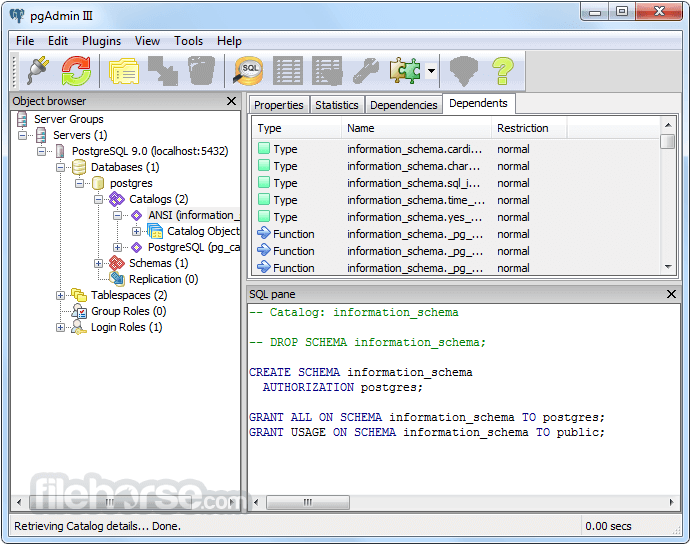
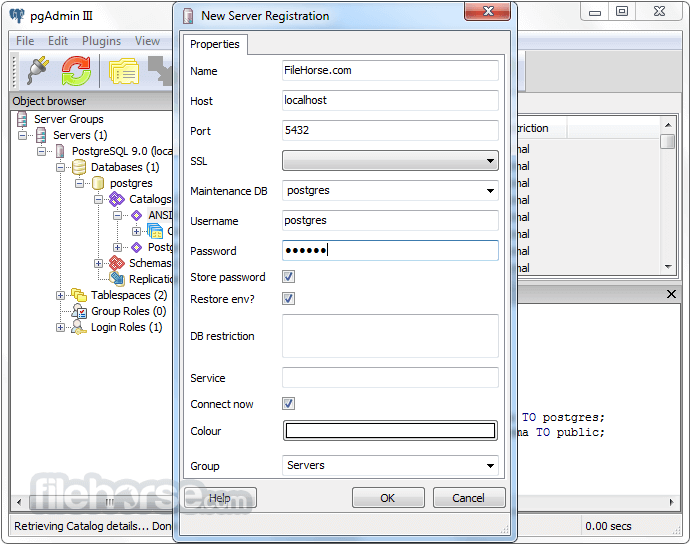
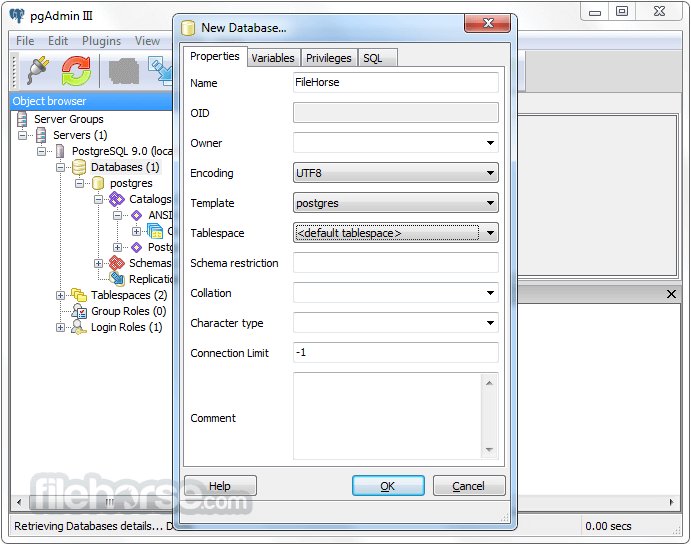
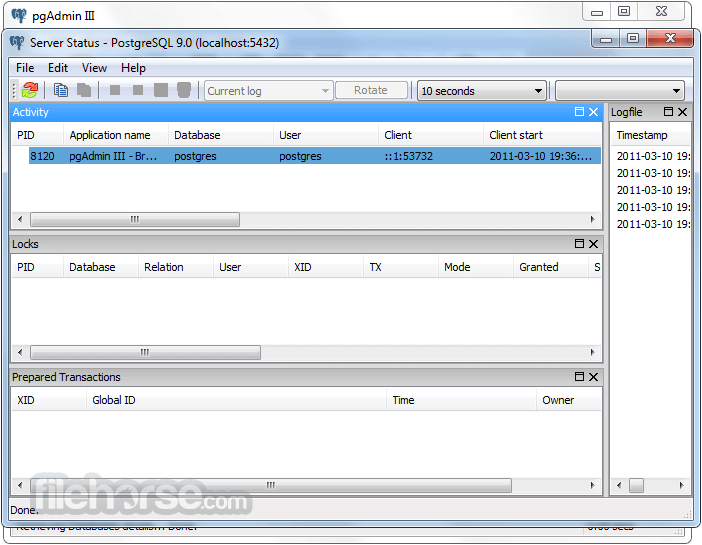
更新日誌
9.1.3 # Changes
* Require execute permission on the trigger function for CREATE TRIGGER
- This missing check could allow another user to execute a trigger function with forged input data, by installing it on a table he owns. This is only of significance for trigger functions marked SECURITY DEFINER, since otherwise trigger functions run as the table owner anyway.
* Remove arbitrary limitation on length of common name in SSL certificates
- Both libpq and the server truncated the common name extracted from an SSL certificate at 32 bytes. Normally this would cause nothing worse than an unexpected verification failure, but there are some rather-implausible scenarios in which it might allow one certificate holder to impersonate another. The victim would have to have a common name exactly 32 bytes long, and the attacker would have to persuade a trusted CA to issue a certificate in which the common name has that string as a prefix. Impersonating a server would also require some additional exploit to redirect client connections.
* Convert newlines to spaces in names written in pg_dump comments
- pg_dump was incautious about sanitizing object names that are emitted within SQL comments in its output script. A name containing a newline would at least render the script syntactically incorrect. Maliciously crafted object names could present a SQL injection risk when the script is reloaded.
* Fix btree index corruption from insertions concurrent with vacuuming
- An index page split caused by an insertion could sometimes cause a concurrently-running VACUUM to miss removing index entries that it should remove. After the corresponding table rows are removed, the dangling index entries would cause errors (such as "could not read block N in file ...") or worse, silently wrong query results after unrelated rows are re-inserted at the now-free table locations. This bug has been present since release 8.2, but occurs so infrequently that it was not diagnosed until now. If you have reason to suspect that it has happened in your database, reindexing the affected index will fix things.
* Fix transient zeroing of shared buffers during WAL replay
- The replay logic would sometimes zero and refill a shared buffer, so that the contents were transiently invalid. In hot standby mode this can result in a query that's executing in parallel seeing garbage data. Various symptoms could result from that, but the most common one seems to be "invalid memory alloc request size".
* Fix handling of data-modifying WITH subplans in READ COMMITTED rechecking
- A WITH clause containing INSERT/UPDATE/DELETE would crash if the parent UPDATE or DELETE command needed to be re-evaluated at one or more rows due to concurrent updates in READ COMMITTED mode.
* Fix corner case in SSI transaction cleanup
- When finishing up a read-write serializable transaction, a crash could occur if all remaining active serializable transactions are read-only.
* Fix postmaster to attempt restart after a hot-standby crash
- A logic error caused the postmaster to terminate, rather than attempt to restart the cluster, if any backend process crashed while operating in hot standby mode.
* Fix CLUSTER/VACUUM FULL handling of toast values owned by recently-updated rows
- This oversight could lead to "duplicate key value violates unique constraint" errors being reported against the toast table's index during one of these commands.
* Update per-column permissions, not only per-table permissions, when changing table owner
- Failure to do this meant that any previously granted column permissions were still shown as having been granted by the old owner. This meant that neither the new owner nor a superuser could revoke the now-untraceable-to-table-owner permissions.
* Support foreign data wrappers and foreign servers in REASSIGN OWNED
- This command failed with "unexpected classid" errors if it needed to change the ownership of any such objects.
* Allow non-existent values for some settings in ALTER USER/DATABASE SET
- Allow default_text_search_config, default_tablespace, and temp_tablespaces to be set to names that are not known. This is because they might be known in another database where the setting is intended to be used, or for the tablespace cases because the tablespace might not be created yet. The same issue was previously recognized for search_path, and these settings now act like that one.
* Fix "unsupported node type" error caused by COLLATE in an INSERT expression
* Avoid crashing when we have problems deleting table files post-commit
- Dropping a table should lead to deleting the underlying disk files only after the transaction commits. In event of failure then (for instance, because of wrong file permissions) the code is supposed to just emit a warning message and go on, since it's too late to abort the transaction. This logic got broken as of release 8.4, causing such situations to result in a PANIC and an unrestartable database.
* Recover from errors occurring during WAL replay of DROP TABLESPACE
- Replay will attempt to remove the tablespace's directories, but there are various reasons why this might fail (for example, incorrect ownership or permissions on those directories). Formerly the replay code would panic, rendering the database unrestartable without manual intervention. It seems better to log the problem and continue, since the only consequence of failure to remove the directories is some wasted disk space.
* Fix race condition in logging AccessExclusiveLocks for hot standby
- Sometimes a lock would be logged as being held by "transaction zero". This is at least known to produce assertion failures on slave servers, and might be the cause of more serious problems.
* Track the OID counter correctly during WAL replay, even when it wraps around
- Previously the OID counter would remain stuck at a high value until the system exited replay mode. The practical consequences of that are usually nil, but there are scenarios wherein a standby server that's been promoted to master might take a long time to advance the OID counter to a reasonable value once values are needed.
* Prevent emitting misleading "consistent recovery state reached" log message at the beginning of crash recovery
* Fix initial value of pg_stat_replication.replay_location
- Previously, the value shown would be wrong until at least one WAL record had been replayed.
* Fix regular expression back-references with * attached
- Rather than enforcing an exact string match, the code would effectively accept any string that satisfies the pattern sub-expression referenced by the back-reference symbol.
- A similar problem still afflicts back-references that are embedded in a larger quantified expression, rather than being the immediate subject of the quantifier. This will be addressed in a future PostgreSQL release.
* Fix recently-introduced memory leak in processing of inet/cidr values
- A patch in the December 2011 releases of PostgreSQL caused memory leakage in these operations, which could be significant in scenarios such as building a btree index on such a column.
* Fix planner's ability to push down index-expression restrictions through UNION ALL
- This type of optimization was inadvertently disabled by a fix for another problem in 9.1.2.
* Fix planning of WITH clauses referenced in UPDATE/DELETE on an inherited table
- This bug led to "could not find plan for CTE" failures.
* Fix GIN cost estimation to handle column IN (...) index conditions
- This oversight would usually lead to crashes if such a condition could be used with a GIN index.
* Prevent assertion failure when exiting a session with an open, failed transaction
- This bug has no impact on normal builds with asserts not enabled.
* Fix dangling pointer after CREATE TABLE AS/SELECT INTO in a SQL-language function
- In most cases this only led to an assertion failure in assert-enabled builds, but worse consequences seem possible.
* Avoid double close of file handle in syslogger on Windows
- Ordinarily this error was invisible, but it would cause an exception when running on a debug version of Windows.
* Fix I/O-conversion-related memory leaks in plpgsql
- Certain operations would leak memory until the end of the current function.
* Work around bug in perl's SvPVutf8() function
- This function crashes when handed a typeglob or certain read-only objects such as $^V. Make plperl avoid passing those to it.
* In pg_dump, don't dump contents of an extension's configuration tables if the extension itself is not being dumped
* Improve pg_dump's handling of inherited table columns
- pg_dump mishandled situations where a child column has a different default expression than its parent column. If the default is textually identical to the parent's default, but not actually the same (for instance, because of schema search path differences) it would not be recognized as different, so that after dump and restore the child would be allowed to inherit the parent's default. Child columns that are NOT NULL where their parent is not could also be restored subtly incorrectly.
* Fix pg_restore's direct-to-database mode for INSERT-style table data
- Direct-to-database restores from archive files made with --inserts or --column-inserts options fail when using pg_restore from a release dated September or December 2011, as a result of an oversight in a fix for another problem. The archive file itself is not at fault, and text-mode output is okay.
* Teach pg_upgrade to handle renaming of plpython's shared library
- Upgrading a pre-9.1 database that included plpython would fail because of this oversight.
* Allow pg_upgrade to process tables containing regclass columns
- Since pg_upgrade now takes care to preserve pg_class OIDs, there was no longer any reason for this restriction.
* Make libpq ignore ENOTDIR errors when looking for an SSL client certificate file
- This allows SSL connections to be established, though without a certificate, even when the user's home directory is set to something like /dev/null.
* Fix some more field alignment issues in ecpg's SQLDA area
* Allow AT option in ecpg DEALLOCATE statements
- The infrastructure to support this has been there for awhile, but through an oversight there was still an error check rejecting the case.
* Do not use the variable name when defining a varchar structure in ecpg
* Fix contrib/auto_explain's JSON output mode to produce valid JSON
- The output used brackets at the top level, when it should have used braces.
* Fix error in contrib/intarray's int[] & int[] operator
- If the smallest integer the two input arrays have in common is 1, and there are smaller values in either array, then 1 would be incorrectly omitted from the result.
* Fix error detection in contrib/pgcrypto's encrypt_iv() and decrypt_iv()
- These functions failed to report certain types of invalid-input errors, and would instead return random garbage values for incorrect input.
* Fix one-byte buffer overrun in contrib/test_parser
- The code would try to read one more byte than it should, which would crash in corner cases. Since contrib/test_parser is only example code, this is not a security issue in itself, but bad example code is still bad.
* Use __sync_lock_test_and_set() for spinlocks on ARM, if available
- This function replaces our previous use of the SWPB instruction, which is deprecated and not available on ARMv6 and later. Reports suggest that the old code doesn't fail in an obvious way on recent ARM boards, but simply doesn't interlock concurrent accesses, leading to bizarre failures in multiprocess operation.
* Use -fexcess-precision=standard option when building with gcc versions that accept it
- This prevents assorted scenarios wherein recent versions of gcc will produce creative results.
* Allow use of threaded Python on FreeBSD
- Our configure script previously believed that this combination wouldn't work; but FreeBSD fixed the problem, so remove that error check.
* Allow MinGW builds to use standardly-named OpenSSL libraries
- 2026-05-18 PostgreSQL 16.14 349 MB
- 2026-05-17 PostgreSQL 17.10 357 MB
- 2026-05-15 PostgreSQL 18.4 357 MB
- 2026-02-27 PostgreSQL 16.13 347 MB
- 2026-02-27 PostgreSQL 17.9 354 MB
- 2026-02-27 PostgreSQL 18.3 355 MB
- 2026-02-13 PostgreSQL 17.8 354 MB
- 2026-02-13 PostgreSQL 18.2 354 MB